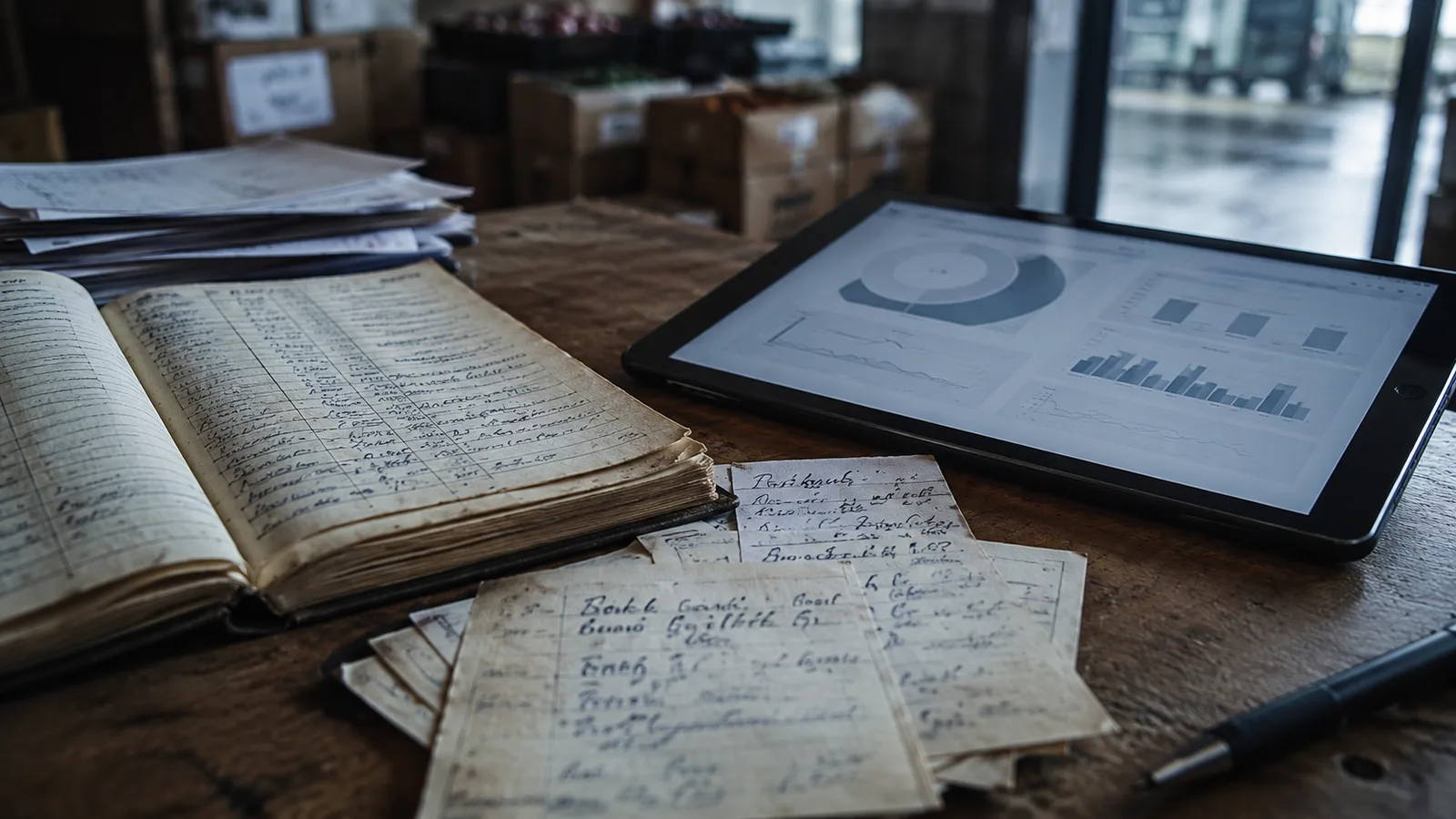
When a wholesaler or a traditional food importer starts thinking about "modernizing," they usually picture one of two scenes. The first: ripping out the fifteen-year-old ERP and migrating to a new system, with the months of chaos, the disoriented team, and the invoice that comes with it. The second: doing nothing, because the first one is too frightening.
There is a third path, and it is the only one that makes sense for a company that already invoices, already delivers, and already works: don't replace the system, grow it from the outside. Start with a small layer that coexists with what's already there, automate around the current way of working without forcing anyone, and let that layer gain weight until it becomes — if the business calls for it — the custom CRM or ERP the company needed from the start.
It's not a project. It's a process.
Why the "big bang" fails in food distribution
Replacing the core system of a distributor overnight is one of the riskiest moves it can make. And in food, with its particularities — high turnover, fresh and frozen goods, mandatory traceability, order peaks — the risk multiplies.
The reason is simple: in a company that has been operating for years, the knowledge doesn't live only in the software. It lives in the habits. The purchasing manager can read their spreadsheet at a glance. The warehouse has a rhythm of delivery notes that never fails. The sales rep records orders the way they always have. When the system is changed all at once, all that tacit knowledge is left with nothing to lean on, and the company spends weeks working worse at precisely what it used to do well.
That's why forced digitalization breeds resistance. Not because the team rejects change on a whim, but because the change is imposed on top of a way of working that was functioning.
The alternative: a layer that starts small and grows
The opposite approach starts from an uncomfortable but realistic idea: on day one, the manual process stays as it is. It isn't touched. What gets built is a software layer on top of the current system that begins by solving a single thing, and connects to the existing ERP through the paths already available — exports, files, simple integrations — without asking anyone to change their routine.
From there, growth is progressive:
Phase 1 — A lightweight CRM that brings order to the commercial side. Before touching anything in the ERP, a layer is set up that centralizes what is scattered today: which client buys what, how often, which quotes are open, what follow-up has been done. It feeds on the data the current system already generates. The ERP doesn't even notice; it remains the core system. But for the first time there is a clean commercial view.
Phase 2 — Automations that surround the manual process rather than replace it. The sales rep keeps recording orders as always; the system, in parallel, normalizes and posts those orders without anyone keying them in twice. Margin calculation, which used to arrive late, starts being available in the moment. Alerts — a recurring client who stops ordering, a batch that needs tracing — get automated. None of this forces a change in the underlying habit. It accompanies it.
Phase 3 — The layer absorbs functions, by choice, not by decree. A point arrives where the team prefers to enter the order directly into the new layer because it's more convenient than the old method. When that happens, the manual process lets go on its own. Not because it was forbidden, but because it has stopped being the easiest path. It is then — and only then — that it makes sense to consider whether that layer becomes the company's definitive custom CRM or ERP.
The custom system is not the traumatic starting point. It's the destination reached by accumulation, once it's already proven its worth.
Why a custom system is viable for an SME today
For years, "custom ERP or CRM" was the exclusive territory of large companies: developments spanning many months, entire teams, six-figure budgets. That barrier has fallen.
Today's stack — modern databases, visual process automation, language models for reading, extraction, and writing tasks — makes it possible to build a system designed exactly for one specific distributor without the cost or the timelines of the past. And, above all, it allows it to be built in pieces: there's no need to deliver the complete system on day one to start adding value. The first useful piece ships in weeks, and the rest is added as the business justifies it.
That changes the economics of the decision. It's no longer a choice between "I live with the old ERP forever" or "I throw myself into a huge project." You can start with the smallest, most profitable piece, and let actual usage decide how far it grows.
The criterion isn't technical, it's about the business
The question that decides where to start isn't "which technology do I use?" It's "which task eats up the most hours, which error costs the most, which decision is being made with data that arrives too late?" That diagnosis — understanding the business before proposing the tool, and respecting how the team works today before changing anything — is what separates a system that gets adopted from one that gets abandoned.
A food distributor doesn't need a technological leap of faith. It needs to shed friction without losing what it already does well. The way to achieve that isn't to break and rebuild. It's to add the right piece, let it prove its value, and grow from there.
*Isenzo-IA is a practical AI consultancy for SMEs based in Baix Llobregat (Barcelona). We work with accounting firms, professional practices, clinics, and distribution companies, guided by one simple principle: diagnosis before solution, and respect for how the team already works.*